

Manual Athlete Evaluations Work Only at a Small Scale
Most sports clubs begin with manual athlete evaluations.
Paper forms, printed rubrics, notebooks, or simple spreadsheets feel easy to manage in the early stages.
When a club has a small number of athletes and only one or two coaches, this approach often feels sufficient.
At this stage, evaluations are informal, records are easy to remember, and communication happens face to face.
However, this setup depends heavily on people rather than systems.
As soon as the club grows, these methods begin to show their limits.
Growth Changes How Evaluations Need to Work
Growth introduces complexity.
More athletes join, programs expand, and additional coaches or evaluators become involved.
Parents expect clearer communication, and administrators need better oversight.
Manual evaluation methods are not designed for this level of coordination.
What once felt flexible starts to feel fragile.
Evaluations become harder to manage, and consistency becomes difficult to maintain across sessions, teams, and seasons.
Inconsistency Becomes the First Major Problem
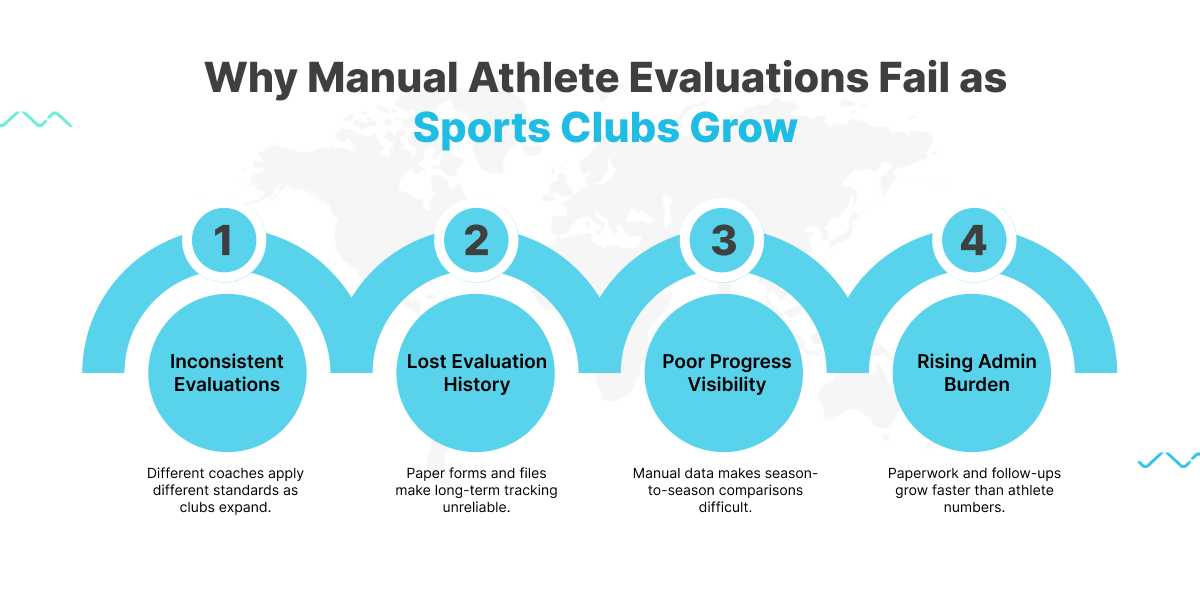
One of the earliest signs of failure in manual evaluation systems is inconsistency.
Different coaches apply different standards.
Evaluation criteria change over time.
Athletes receive mixed feedback depending on who evaluates them.
Without a shared framework, evaluations become subjective.
This makes it difficult to measure progress fairly and creates confusion for athletes and parents.
As the club grows, this inconsistency becomes more visible and harder to correct.
Evaluation Records Stop Telling a Clear Story
Manual systems rarely produce a reliable evaluation history.
Paper forms are stored in folders, spreadsheets are saved on personal devices, and notes are often incomplete or missing.
When clubs try to look back at past evaluations, records are difficult to locate or compare.
This breaks continuity and prevents clubs from understanding long-term athlete development.
Growth exposes this gap quickly, especially when new coaches join without access to historical context.
Progress Tracking Becomes Unmanageable
As athlete numbers increase, clubs naturally want to track development over time.
They want to understand how athletes improve across seasons, how programs perform, and whether development goals are being met.
Manual evaluation methods make this difficult.
Data lives in different formats and locations, making comparison slow and unreliable.
Over time, clubs lose the ability to track meaningful progress at scale.
Administrative Work Increases Disproportionately
Manual evaluations add hidden administrative work.
Someone must collect forms, organize records, answer questions, and prepare reports.
As the club grows, this workload increases faster than athlete numbers.
What starts as a manageable task becomes a recurring burden.
Administrators and volunteers spend more time managing paperwork than supporting athletes and programs.
This often leads to rushed processes or burnout.
Parent Communication Becomes Less Clear
In youth sports especially, parents want transparency.
They want to understand how evaluations are done and what progress looks like.
Manual systems make this difficult.
Feedback is often verbal, inconsistent, or delayed.
Written records are not always easy to share.
As expectations increase, clubs struggle to communicate clearly using manual tools.
This can affect trust and satisfaction.
Manual Systems Do Not Scale Across Programs
Clubs that run multiple programs face additional challenges.
Each program may use different evaluation formats or criteria.
Standards vary, and reporting becomes fragmented.
Without a centralized system, scaling evaluations across programs creates confusion and inefficiency.
Growth highlights these gaps more clearly with every new season.
Why Manual Fixes Stop Working
Many clubs try to improve manual systems instead of replacing them.
They redesign paper forms, create new spreadsheets, or ask coaches to be more consistent.
These efforts help temporarily but do not solve the underlying issue.
Manual systems lack structure, visibility, and scalability.
As complexity increases, these fixes become harder to maintain.
What Growing Clubs Actually Need
As clubs grow, they need consistent evaluation criteria, centralized records, and the ability to track progress over time.
They also need evaluation processes that are easy for coaches to use and easy for admins to manage.
These needs cannot be met reliably with paper forms and spreadsheets alone.
How Digital Evaluation Systems Change the Situation
Digital athlete evaluation systems introduce structure into the evaluation process.
Evaluations follow defined criteria.
Records are stored centrally.
Historical data remains accessible.
This allows clubs to grow without losing consistency, visibility, or control.
Evaluations become part of a system rather than isolated tasks.
Where Checklick Fits
Checklick supports sports clubs that have outgrown manual athlete evaluations.
The platform is designed around digital evaluation checklists, consistent assessment workflows, and centralized progress tracking.
Checklick helps clubs move from fragmented evaluation habits to a structured system that supports growth and long-term development.
Final Thoughts
Manual athlete evaluations do not fail because clubs use them incorrectly.
They fail because growth changes the demands placed on evaluation systems.
What works for small clubs breaks under scale.
In 2026, clubs that want consistency, transparency, and reliable development tracking need structured digital evaluation systems.
That is why growing sports clubs are moving away from manual evaluations and toward systems built for scale.
