

Youth sports clubs have a resource that is both their greatest strength and their most significant constraint: volunteer labor. The parents, coaches, and community members who donate their time make these organizations possible. But there is only so much volunteer time to go around, and when a disproportionate share of that time goes to administrative tasks – registration processing, payment tracking, evaluation paperwork, and communication management – the organization’s core mission suffers.
The most effective way to protect volunteer time is to eliminate the manual processes that consume it. Digital management systems automate the repetitive, time-consuming tasks that currently burden volunteers, allowing clubs to accomplish more with fewer administrative hours.
This is not theoretical. Clubs that have made this transition report specific, measurable time savings that translate directly into better programs and more sustainable volunteer commitments.
Where Volunteer Time Goes
Before examining solutions, it is important to understand where volunteer administrative time is actually spent. In most youth sports clubs operating with manual processes, the biggest time sinks fall into predictable categories.
Registration management involves collecting enrollment forms, confirming receipt, tracking who has and has not completed the process, and following up with families who started but did not finish. When registration is done via email or paper forms, every enrollment requires individual handling.
Payment collection and tracking consumes enormous volunteer hours when done manually. The Gimli Yacht Club experienced this directly – payments were typically made by cash or check, often not collected until after the program had ended. Each registration required manual confirmation, and chasing down registration fees stretched well into the fall.
Evaluation administration includes distributing checklists to coaches, collecting completed evaluations, transcribing handwritten notes into records, preparing progress reports for parents, and generating certificates.
Communication management covers emails to parents about schedules, updates, payment reminders, program changes, and end-of-season summaries. In clubs without centralized systems, this communication is often handled through personal email accounts with no organizational archive.
Verified Time Savings: The Gimli Yacht Club Example
The most specific time-savings data comes from Gimli Yacht Club, which transitioned from manual registration to Checklick’s digital platform. The results were documented in their success story.
Before Checklick, the club managed registrations manually, handling signups through email with payments by cash or check. Many members would register verbally in person, making it difficult to track commitments. Each registration required manual confirmation.
After implementing Checklick, volunteers save an estimated 15 minutes on each registration. With 80 participants, the club saves roughly 20 volunteer hours per year. The sailing program has expanded since implementing Checklick, and a single, streamlined system now handles all registrations efficiently.
These numbers are significant in context. Twenty hours represents multiple weekends of volunteer time recovered. For a small club relying on a handful of dedicated volunteers, that is the difference between an administration load that is manageable and one that drives people away.
How Digital Registration Reduces Hours
The registration time savings come from eliminating manual steps at every stage of the process.
First, online registration eliminates the need for volunteers to manually process enrollment forms. When families register through Checklick’s Storefront, their information goes directly into the system. There is no data entry step, no deciphering handwriting, and no need to confirm receipt via email.
Second, requiring payment at the time of registration eliminates the entire category of payment follow-up. Gimli Yacht Club implemented this approach – all registrations were required to be paid by credit card at the time of sign-up, eliminating delays in fee collection. The process was centralized through a single online entry point.
Third, automated receipts eliminate the need for volunteers to generate and distribute confirmations. Checklick automatically emails branded PDF receipts to every customer, so families know their registration is complete without requiring any volunteer action.
Fourth, enrollment management features prevent over-subscription automatically. The platform includes enrollment limits, so volunteers do not need to manually track how many spots are left and communicate closures.
Reducing Evaluation Administration
Evaluation is another area where digital systems significantly reduce volunteer hours. When coaches evaluate athletes using Checklick’s mobile platform, the evaluation data goes directly into the system. There is no paper-to-digital transcription step.
This matters at scale. If a club has 80 participants and each evaluation takes even 5 minutes to manually transcribe from paper to a digital record, that is nearly 7 hours of additional administrative work per evaluation cycle. With real-time digital evaluation, that transcription step does not exist.
Checklick enables coaches to use their phone or tablet to evaluate participants as they progress through programs. The platform supports customized skill matrices that structure the evaluation process, making it fast and consistent. The evaluation data immediately appears in the participant’s record, accessible to administrators, other coaches, and parents.
Eliminating Cash Handling
Cash and check handling is not just a time cost – it is also a risk that volunteers should not have to manage. Barrie Yacht Club initially collected payments by check, which posed several risks, including minors handling large sums of money and misplaced payments.
West Hawk Lake Yacht Club relied on cash collection, which meant administrative tasks were performed without digital records. After adopting Checklick, the club eliminated paperwork and cash handling through online registration. Registration fees were no longer collected in cash, and the platform provided remote access for both organizers and instructors.
When payments are processed digitally through Checklick’s Storefront at 4.9% per transaction with no long-term commitments, volunteers no longer need to count cash, deposit checks, reconcile amounts, or chase outstanding payments. The financial reporting becomes automatic and transparent.
Supporting Volunteer Onboarding
Youth sports clubs experience regular volunteer turnover as children age out of programs and their parents move on. Each new volunteer coordinator needs to learn the administrative systems, and with manual processes, this learning curve is steep because the “system” often exists only in the previous volunteer’s head.
Digital platforms reduce this onboarding burden dramatically. When all registration data, evaluation records, payment histories, and communication logs live in a centralized system like Checklick, a new volunteer can access everything from day one. There is no need for a lengthy handoff process or the risk that institutional knowledge leaves when a volunteer does.
Real-Time Instructor Access
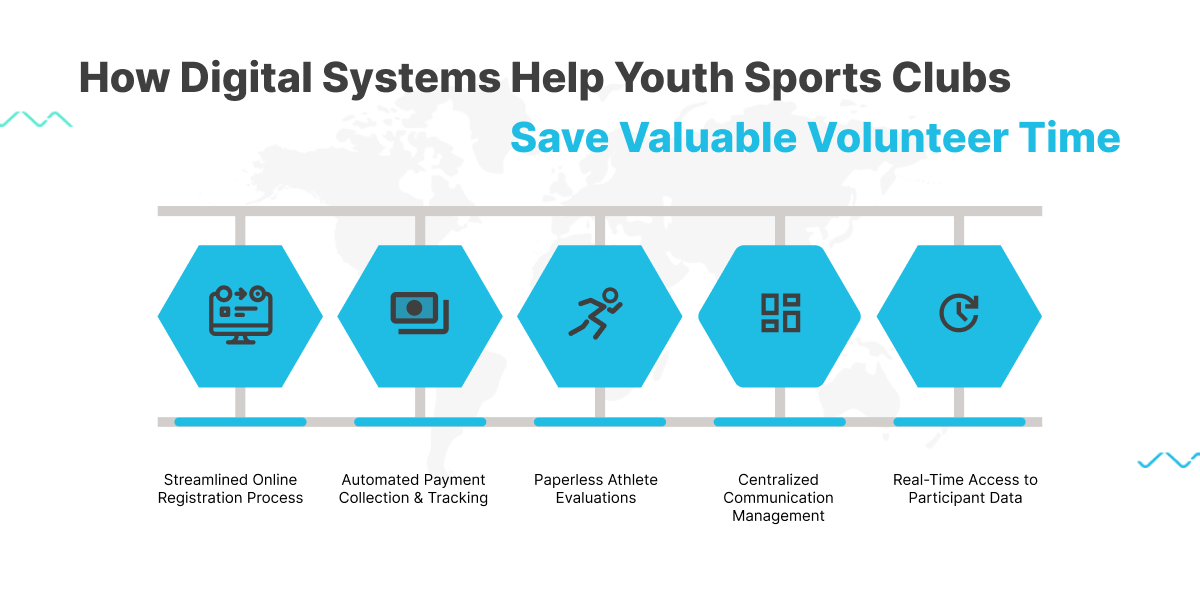
Volunteer coaches and instructors also benefit from digital systems. Before Checklick, instructors at multiple clubs lacked easy access to updated participant lists. At West Hawk Lake Yacht Club, the platform provided real-time participant lists to instructors, eliminating the need for volunteers to manually update and distribute rosters.
Starlight Sailing Adventures similarly reported that instructors now access the platform to view up-to-date class lists and record student progress directly. Administrators use the system for registration coordination, evaluation submissions, and managing overall program records.
This means volunteer coordinators do not need to manually prepare and distribute class lists before each session – the information is always current in the platform.
The Compound Effect
The individual time savings from digital registration, automated payments, mobile evaluation, and centralized records compound into a significant total impact. When a club saves 15 minutes per registration across 80 participants, eliminates payment follow-up, removes evaluation transcription, and automates receipt generation, the total time recovered can represent days of volunteer labor over a season.
More importantly, the quality of volunteer time changes. Instead of spending weekends on data entry and payment chasing, volunteers can focus on program development, coaching, community engagement, and the activities that actually motivated them to volunteer in the first place.
Getting Started
Checklick offers a 30-day free trial so clubs can evaluate the platform with real data before committing. The $15/month evaluator package for organizations with fewer than 50 evaluators keeps the cost accessible for volunteer-run clubs. Managed services packages with implementation specialists, custom branding, and consulting services are available for larger organizations.
Hundreds of sports clubs trust Checklick to simplify evaluations, sell programs online, and manage athlete development. The platform was designed with sports clubs and instructors in mind, with an intuitive system that simplifies every aspect of club management.
Every hour saved in administration is an hour returned to the mission that brought volunteers to the club in the first place: developing young athletes.
Ready to give your volunteers their time back? Start your 30-day free trial at www.checklick.com
