

Somewhere in a storage room at a sports club, there is a box of binders from three seasons ago. Inside those binders are evaluation sheets with handwritten notes about dozens of athletes – their skill levels, their certification progress, their instructor’s observations about strengths and areas for development. That box has not been opened since the volunteer who organized it moved on. The next coordinator did not know it existed. The one after that started fresh.
This scenario plays out at sports clubs every year. Athlete records disappear – not because of a catastrophic event, but through the gradual erosion that comes from paper-based systems, volunteer turnover, and the absence of centralized digital storage. The consequences are subtle but compounding: returning athletes are evaluated from scratch, certification histories are unverifiable, program continuity is lost, and the organization’s ability to demonstrate its track record erodes over time.
Digital record-keeping systems prevent these losses by creating persistent, centralized, and accessible documentation that survives the natural turnover of seasonal sports club operations.
Why Records Get Lost
Athlete records in manual systems are vulnerable at multiple points.
Volunteer turnover is the primary cause. Most community sports clubs are run by volunteers who serve for a limited time – often just the years their own children participate. When a volunteer coordinator steps down, the records they maintain may be stored in a box, on a personal computer, in a personal email account, or nowhere at all. The incoming coordinator may not even know those records exist.
Seasonal gaps compound the problem. Many sports clubs operate seasonally, with months of inactivity between programs. During these gaps, storage arrangements change, facilities are reorganized, and records that were “in the office” during the season may end up in storage during the off-season and never retrieved.
Format fragmentation makes records harder to maintain. Some information is on paper. Some is in a spreadsheet on someone’s laptop. Some exist only in email threads. When records are scattered across formats and locations, maintaining a complete picture of any individual athlete’s history becomes practically impossible.
The Specific Costs of Lost Records
Lost athlete records carry concrete costs for sports clubs.
First, returning athletes must be re-evaluated from scratch when their previous records are unavailable. If a sailor achieved CANSail 2 last season but the evaluation records are lost, the instructor must either take the family’s word for it or conduct a new assessment. Both options waste time and create uncertainty.
Second, certification histories become unverifiable. Port Dover Yacht Club works with changing CANSail levels and evolving program structures. When certification records are maintained digitally, the club can track each sailor’s progression precisely. When they are not, the organization cannot confidently verify credentials – undermining the value of the certifications themselves.
Third, institutional memory disappears. The cumulative knowledge that a club builds about its athletes, programs, and operations over multiple seasons has enormous value for program development. When records are lost, that knowledge goes with them.
Fourth, regulatory and compliance requirements may go unmet. Organizations working within national certification frameworks need verifiable records. Without them, the organization risks losing its standing with the national body.
How Digital Systems Prevent Record Loss
Digital record-keeping addresses each vulnerability in the manual system.
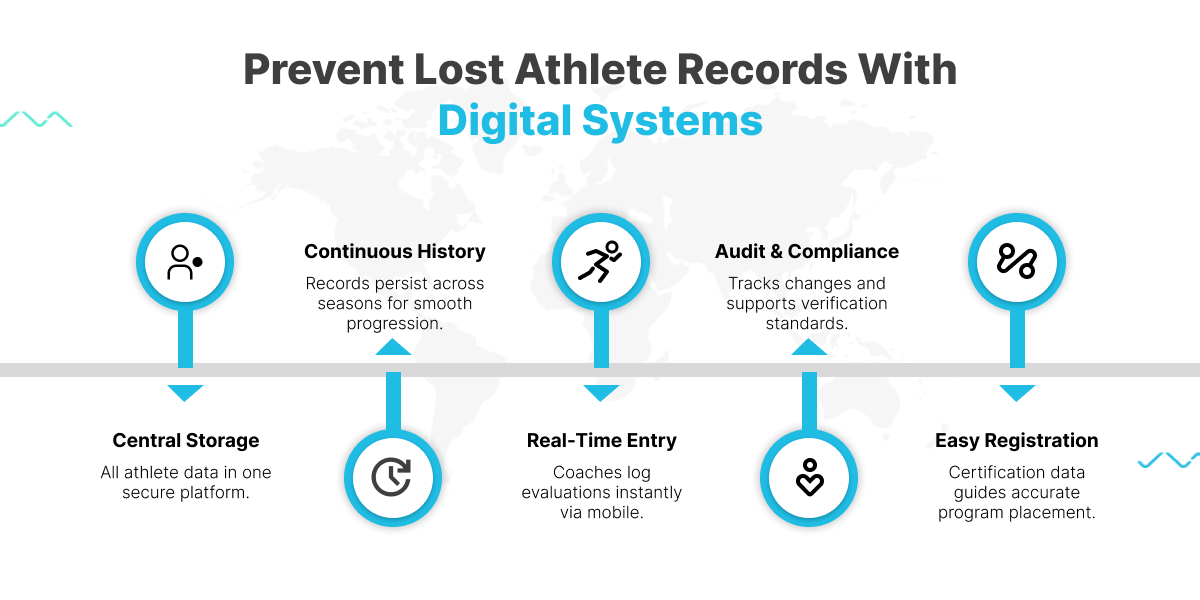
Centralized storage means all records live in one platform, accessible to any authorized user. When a volunteer coordinator changes, the records stay in the system. The new coordinator can log in and access everything the previous coordinator had – registration histories, evaluation records, payment data, and certification documentation.
Checklick provides this centralized approach as part of its all-in-one platform. The system stores registration data, evaluation records, certification information, and payment histories in a single, accessible location. Instructors can view up-to-date information from any device with an internet connection.
Persistent access eliminates seasonal gaps. Digital records do not get boxed up during the off-season. They remain accessible year-round, so when a new season starts, the club’s complete history is immediately available. Returning athletes’ records are already in the system, and instructors can review previous evaluations before the first day of programming.
Structured data replaces format fragmentation. When all records are created within the same platform – registration through the Storefront, evaluations through the mobile tool, certifications through the tracking system – the data is consistently formatted, searchable, and connected. There are no orphaned spreadsheets or disconnected email threads.
Real-Time Record Creation
One of the most powerful features of digital systems is that records are created in real time, during the activities they document. Rather than creating records after the fact – which is where many manual processes fail – digital tools capture information as it happens.
Checklick enables coaches to evaluate athletes using their phone or tablet in real time during practice, instruction, and competition. When a coach checks off a skill in the mobile evaluation tool, that record is immediately stored in the system. There is no transcription step, no paper form to lose, and no delay between observation and documentation.
West Hawk Lake Yacht Club experienced this shift directly. Before Checklick, instructors lacked easy access to updated participant lists and administrative tasks were performed without digital records. After implementation, instructors got instant access through real-time access features, and the club eliminated paperwork through online registration. Financial reporting became more streamlined, and mobile usability improved.
Audit Trails and Accountability
Digital records include something that paper records rarely provide: audit trails. An audit trail documents who created or modified a record, when, and what changes were made. This is essential for certification records, where the integrity of the evaluation process must be verifiable.
Starlight Sailing Adventures uses Checklick as a Sail Canada recognized platform specifically because it supports audit trails and ensures compliance with national standards. The platform centralized records and eliminated the scattered, manual processes that made audit compliance difficult.
For any club that issues certifications – whether formal national certifications or internal achievement recognitions – the ability to demonstrate when and how each certification was earned adds credibility and protects the organization in case of disputes.
Connecting Records Across Seasons
Digital systems make it possible to maintain a continuous athlete record across multiple seasons, programs, and even different levels within a certification framework.
Port Credit Yacht Club uses Checklick’s built-in progression displays to show parents exactly where each participant stands in the program pathway. This is only possible because the platform maintains continuous records – last season’s evaluation data is connected to this season’s placement, which informs next season’s programming.
Port Dover Yacht Club used the platform’s data to identify eligible sailors for a new two-week advanced program. They sent targeted emails to inform eligible sailors about the opportunity and gathered input on preferred dates through surveys. The result was that the new program sold out and saw high demand. This kind of targeted outreach – identifying athletes who have reached a specific certification level and inviting them to the next step – is impossible without continuous, accessible records.
Protecting Records Through Digital Certifications
When certifications are generated digitally, the certification itself becomes a permanent record. Checklick enables clubs to send progress reports and certificates directly through the platform. Starlight Sailing Adventures reported that all evaluation and certification processes are now handled digitally, resulting in fully digital certifications.
This means the certification record exists on the platform, not on a piece of paper that can be lost by the family or the club. If a family needs a replacement certificate, or if the club needs to verify a certification that was awarded years ago, the information is accessible in the system.
Building Organizational Credibility
Clubs that maintain comprehensive, accessible records demonstrate a level of organizational professionalism that sets them apart. West Hawk Lake Yacht Club reported that smoother operations built trust with participants, and the club appeared more organized and credible. Starlight Sailing Adventures reported a stronger professional presence after implementing digital systems.
This credibility matters for recruitment, retention, and relationships with national organizations. Families are more likely to trust an organization that can show them their child’s complete development history. National organizations are more likely to maintain licensing relationships with training centers that demonstrate reliable record-keeping.
Getting Started With Digital Record-Keeping
The transition to digital record-keeping does not require migrating years of paper records into a new system. The practical approach is to start fresh with digital tools for the current season and build records forward.
Checklick offers a 30-day free trial that gives clubs access to the full platform – evaluations, storefront, certification tracking, and reporting. The $15/month package for organizations with fewer than 50 evaluators makes this accessible for clubs of any size. Managed services packages for larger organizations include implementation specialists, custom branding, training webinars, and consulting services.
Hundreds of sports clubs trust Checklick to manage athlete development. One verified reviewer noted it was their sixth season using Checklick – that is six seasons of continuous, accessible records that would have been at risk in a paper-based system.
The records your club creates today are the institutional memory your club depends on tomorrow. Digital systems ensure that memory is permanent.
Ready to protect your athlete records? Start your 30-day free trial at www.checklick.com
