

The 2026 Milan-Cortina Winter Olympics brought NHL players back to the Olympic stage for the first time since 2014, and the hockey tournament delivered exactly what fans had hoped for. The United States defeated Canada in the gold medal game, Finland took bronze over Slovakia, and the world was reminded of what the sport looks like when its very best players compete on the same ice.
Every player in that tournament, regardless of the country they represented, arrived with a professional development record that stretches back to their earliest competitive days. They were tracked, evaluated, and progressed through structured skill tiers from minor hockey all the way through junior leagues, college programs, or professional development systems. None of them simply showed up and were declared elite. Their development was documented every step of the way.
For hockey clubs that run youth programs, that development infrastructure is not out of reach. In fact, it is exactly what the most effective youth hockey organizations already build, at whatever scale fits their program.
What NHL-Level Development Systems Actually Do
The NHL’s return to the Olympics highlighted something that coaches at every level of the game already know: elite player development is systematic. Professional teams invest heavily in player tracking not just at the performance statistics level, but at the fundamental skill development level. They know which players have strong edge work and which do not. They know which players have completed specific tactical modules. They know exactly where each player is in their development relative to the team’s defined benchmarks.
This kind of systematic knowledge does not happen by watching practice and making mental notes. It happens because someone built a structured evaluation framework, and someone is tracking progress against it consistently. The scale and sophistication differ between an NHL franchise and a community hockey club, but the underlying logic is identical: structured skill matrices, consistent evaluation, documented progress.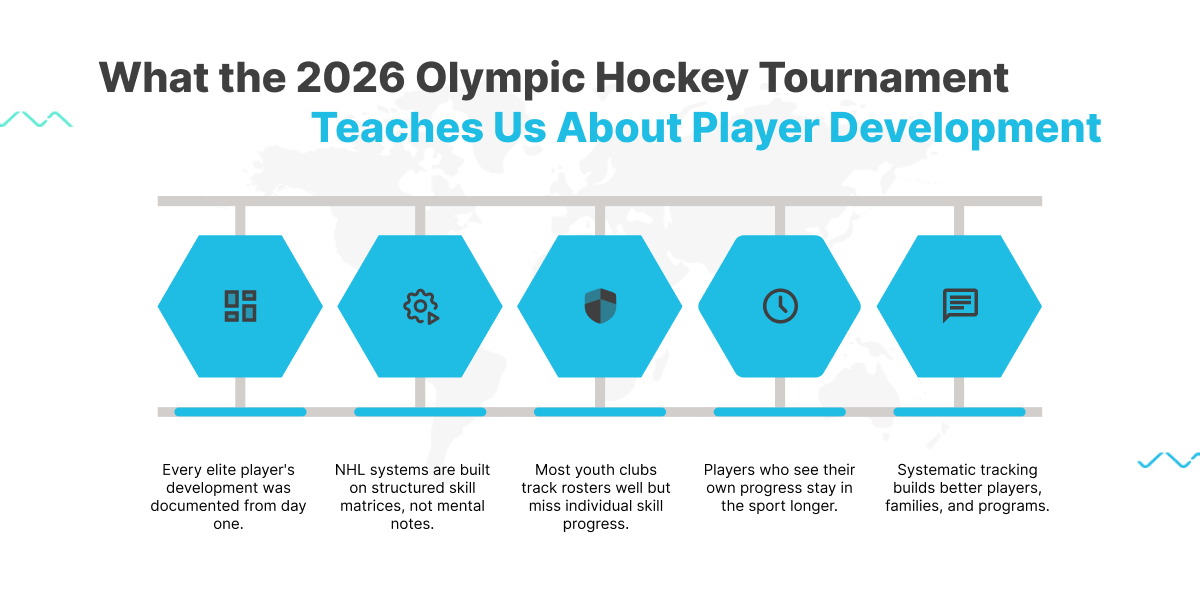
The Gap Most Youth Hockey Clubs Have
Most youth hockey organizations do a good job of running practices, organizing games, and managing rosters. Where many fall short is in the documentation of individual skill development. A player might attend every session for a full season and make significant technical progress, but if that progress is not tracked against specific criteria, the club has no reliable record of it. The coach knows, roughly. But the coach changes. The player moves up an age group. The new coach starts from a general impression rather than a detailed record.
This matters more than it might initially seem. When players and families make decisions about which programs to invest in, they are often responding to whether a club feels serious about development. A club that can show parents a structured skill matrix and a real-time record of exactly what their child has accomplished, and what comes next, signals a level of intentionality that general encouragement cannot replicate.
It also matters for player retention. Young players who can see their own progress in concrete terms stay in the sport longer and develop a deeper commitment to it. The feedback loop between evaluation and motivation is well-established in youth sport development, and it depends on having a system that makes that feedback loop function.
Building a Development System That Actually Scales
For a hockey club to move from informal tracking to structured development documentation does not require starting from scratch. It requires choosing a platform that lets coaches build or adapt a skill matrix aligned to their program, evaluate athletes efficiently during or after sessions, and give players and families access to that record in a meaningful way.
Checklick’s Athlete Development Tracking System supports exactly this workflow. Coaches can create customized skill matrices tailored to the program’s specific development framework, evaluate athlete skills using mobile devices so that recording happens in real time rather than being transcribed later, and send progress updates and digital certificates to participants and families as milestones are completed.
The platform also supports real-time instructor access, meaning that when coaching staff changes between sessions or seasons, the incoming instructor walks in with a complete picture of each player’s documented development history rather than starting from zero.
The Broader Lesson From the Olympic Tournament
The 2026 Olympic hockey tournament was a reminder that the sport produces extraordinary athletes when the development infrastructure is in place. Every player on that ice benefited from coaches and organizations that treated development as something worth documenting and refining over years. The clubs that contributed most meaningfully to that development were the ones that had a system, not just a feeling.
That same principle applies at every level of the sport. A youth hockey club that tracks skill development systematically is not just doing better administration. It is creating the conditions for players to develop more effectively, families to engage more deeply, and programs to grow more sustainably.
Checklick is used across a range of certification-driven sports and is trusted by hundreds of clubs for athlete development management, program registration, and digital certification. The platform is available with a 30-day free trial, with the evaluator plan starting at $15 per month for clubs with fewer than 50 evaluators. For larger programs, a managed services package provides full implementation support.
The world saw what elite player development looks like in Milan-Cortina. The tools to apply that same structured approach at the community level are available, accessible, and already in use at clubs that have decided development is too important to leave undocumented.
See how Checklick supports structured player development. Start your free 30-day trial at checklick.com.
