

How Youth Sports Clubs Can Show Parents Their Child’s Progress (Without Extra Work)
Parents sign their kids up for youth sports because they want them to grow. They want them to build skills, gain confidence, and develop over time. But when the season ends and a parent has no clear sense of whether any of that actually happened, they start asking a question your club does not want them to ask: was this worth it?
That question is often the last thing a family asks before they do not re-enroll.
Showing parents their child’s progress is one of the most powerful things a youth sports club can do. Not because it is a nice extra, but because it directly affects whether families come back, whether they tell other families about your club, and whether they trust the quality of what you deliver.
The challenge most clubs face is not that they do not want to share progress. It is that sharing progress the way most clubs currently operate means someone has to manually compile notes, write up updates, and send them out. That takes time no one has. So it either does not happen, or it happens inconsistently, or it happens once at the end of the season in a rushed conversation that does not really say much.
There is a better way, and it does not create extra work.
Why Parents Ask About Progress More Than You Expect
Parents of youth athletes are paying attention. They drop their child off at practice, pick them up afterward, and have almost no visibility into what happened in between. They know their child had fun or did not. They might hear a few details on the car ride home. But they have no reliable, structured sense of how their child is actually developing.
So they ask. They email the coach. They catch an administrator at the end of a session. They ask at the front desk. They call the club. And every one of those questions takes someone’s time to answer.
Port Credit Yacht Club identified this dynamic clearly. Parents wanted clearer progress updates, and staff needed an easier way to provide them. Without those insights, retaining young sailors after their first seasons felt uncertain. The club adopted Checklick to close the gap. Using Checklick’s built-in progression displays, staff now show parents exactly where each participant stands in the program pathway. The outcome was greater transparency for families and boosted confidence in the club’s long-term pathway.
When parents can see progress on their own, without having to ask, those questions stop coming. And the families who feel informed and confident in what their club is delivering are the ones who keep coming back.
What Parents Actually Want to Know
When a parent asks how their child is doing, they are usually asking one of a few specific things.
Is my child learning the skills they are supposed to be learning? Parents want to know that the program is working and that their child is moving through it in a meaningful way. They do not need a performance score or a ranking. They need to see that their child is progressing through the levels your program is designed to teach.
Is my child keeping up with the program, or falling behind? This is a sensitive question that parents often do not ask directly. But it is on their mind. A clear progress display that shows where their child is in the program pathway answers it without the awkwardness of a conversation.
What should my child be working on? Parents who are engaged in their child’s development want to know what to encourage at home or in informal practice. When a coach’s evaluation shows which skills have been completed and which are still in progress, that information gives parents something concrete to support.
What is the long-term pathway for my child in this program? Parents who are thinking about re-enrollment want to understand where things are headed. If their child completes this level, what comes next? What are they working toward? Clubs that can answer this question clearly and visually have a significant advantage in retaining families across multiple seasons.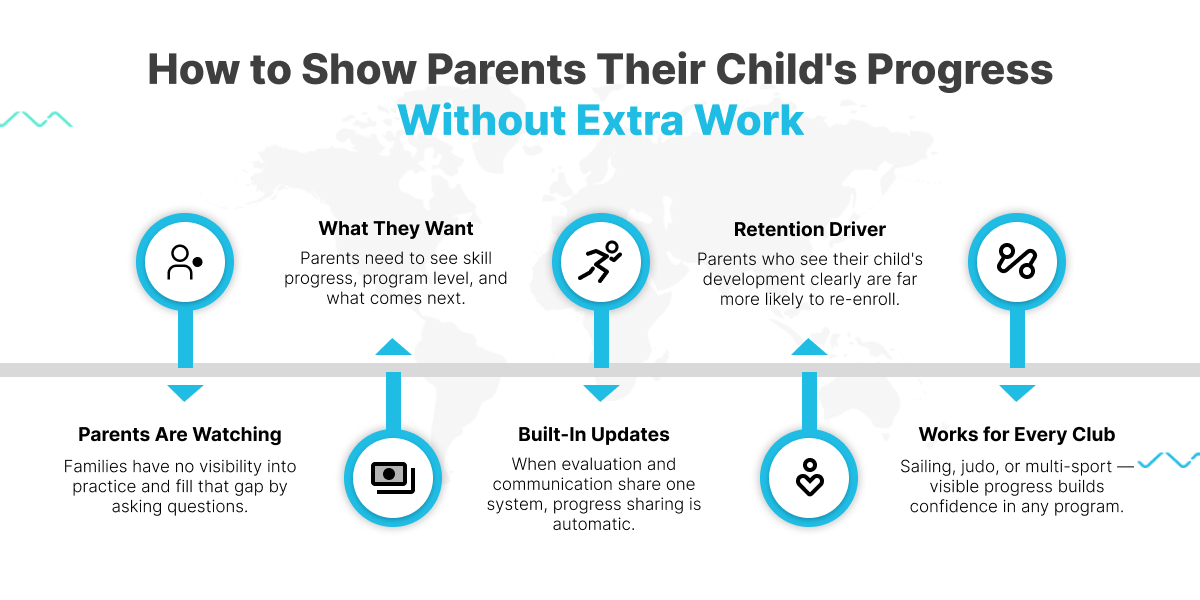 How Progress Sharing Works When It Is Built Into the System
The reason most clubs struggle to share progress is that it requires a separate step. Coaches evaluate athletes in one place. Progress updates have to be compiled somewhere else. Then they have to be sent to families. Every stage of that chain requires manual effort, and manual effort is the thing most clubs have the least of.
When athlete evaluation and parent communication are part of the same system, the chain collapses. A coach evaluates an athlete using Checklick on their phone or tablet during a session. That evaluation is recorded instantly. Parents can see the update without anyone having to do anything extra. The progress sharing happens as a natural byproduct of the evaluation, not as a separate task stacked on top of it.
Checklick’s evaluation platform keeps participants, parents, and coaches informed with personalized skill progression feedback. The system is designed so that the work coaches are already doing, evaluating athletes, automatically produces the progress information that parents need. No extra reports. No manual emails. No end-of-season scramble to compile what happened over the past three months.
Frequent athlete evaluation promotes communication and ongoing development for players, coaches, and parents by tracking progress, setting goals, and recognizing accomplishments. When parents see milestones being recognized in real time, it reinforces the value of the program and keeps them engaged throughout the season, not just at the beginning and end.
The Connection Between Progress Visibility and Retention
Every youth sports club deals with some level of member turnover. Families try a program for a season and do not come back. Some of that is natural. Kids’ interests change. Schedules shift. But a significant portion of turnover happens because families did not feel connected enough to the program to make the commitment to return.
Progress visibility is one of the most direct levers a club has to change that. A parent who watched their child work through a skill progression over the course of a season, who saw milestones recognized and new goals set, who understands what level their child is at and what comes next, is not a parent who is wondering whether the program was worth it. They already know it was. And they are already thinking about next season.
Port Credit Yacht Club was dealing with retention challenges specifically around young sailors after their first seasons. After implementing Checklick’s progression displays and using them to show parents exactly where their child stood in the program pathway, families gained clarity and confidence in the club’s long-term pathway. That clarity directly supported re-enrollment because parents had a concrete reason to come back. Their child was in the middle of a development journey they could see and understand.
What This Looks Like for Different Types of Clubs
For a sailing club, progress visibility might mean parents seeing exactly where their child is in the CANSail pathway, which levels they have completed, and what they are working toward next. Instead of a vague sense that their child is learning to sail, parents see a structured record of their child’s development through a nationally recognized certification program.
For a judo or wrestling club, it might mean parents seeing which techniques their child has been evaluated on and which belt-level requirements they have met. The evaluation criteria give parents a shared language for talking about their child’s progress with coaches and with their child.
For a multi-sport youth program, it might mean parents seeing a simple progress display that shows skills completed and skills still in progress, organized by program level. Even without complex certification frameworks, that kind of visibility tells a clear story about development.
In every case, the underlying principle is the same. Parents who can see what their child is learning, tracked consistently by coaches using a structured evaluation system, are more engaged, more confident in the program, and more likely to stay.
Getting This Set Up at Your Club
If your club is currently sharing parent progress updates manually, or not sharing them at all, moving to a system that handles this automatically is more straightforward than it might seem.
Checklick’s evaluation platform lets you build the skill matrices that define your program levels, deploy them to coaches, and have coaches evaluate athletes directly on their phone or tablet during sessions. Parents see progress updates without anyone having to compile or send them. The evaluations platform starts at fifteen dollars per month for clubs with under fifty evaluators, and there is a thirty-day free trial so you can see how it fits before committing.
The clubs that retain the most families are not necessarily the ones with the best programs. They are the ones who make parents feel informed and confident. Progress visibility is how you do that, and with the right system, it does not cost anyone extra time.
Start your free trial at checklick.com and give parents the visibility they have been looking for.