

Most conversations about sports club management software focus on the club level. Registration for families. Athlete tracking for coaches. Payment processing for administrators. These are real and important needs, and the software that addresses them well makes a genuine difference in how clubs operate.
But there is a layer of Canadian sport governance above the club level that has its own distinct operational needs and that is significantly underserved by most of the software options on the market. That layer is the Provincial Sport Organization, commonly referred to as a PSO.
If you work within a PSO or RSO, or if you are an NSO trying to understand how your provincial partners operate, this blog explains what these organizations actually are, why their management challenges are different from those of individual clubs, and what technology they need to function effectively. You can also read about how national governing bodies like Irish Sailing manage programs at scale in our earlier blog on how Irish Sailing and national governing bodies manage programs across hundreds of clubs
What a PSO Actually Is
A Provincial Sport Organization is the governing body for a specific sport within a Canadian province or territory. It operates between the national sport organization and the individual clubs that deliver programs at the community level. In some sports, the equivalent body is called a Regional Sport Organization or RSO, but the function is the same: to oversee, support, and coordinate sport development across a provincial or regional network of affiliated clubs.
PSOs have a wide range of responsibilities. They develop and maintain the provincial athlete development pathway, ensuring that programs delivered by affiliated clubs align with national standards set by the NSO. They provide coaching development through the National Coaching Certification Program. They manage provincial championships and competitions. They administer funding received from Sport Canada and provincial governments, and they report on program outcomes to those funders. And they maintain relationships with their affiliated clubs, providing resources, guidance, and oversight across their network.
What makes a PSO operationally different from a club is the breadth of what it needs to oversee. A club manages programs and participants in one location. A PSO manages a network of clubs, each of which manages its own programs and participants, across an entire province. The information the PSO needs to do its job effectively does not live in one place. It lives in every club in its network.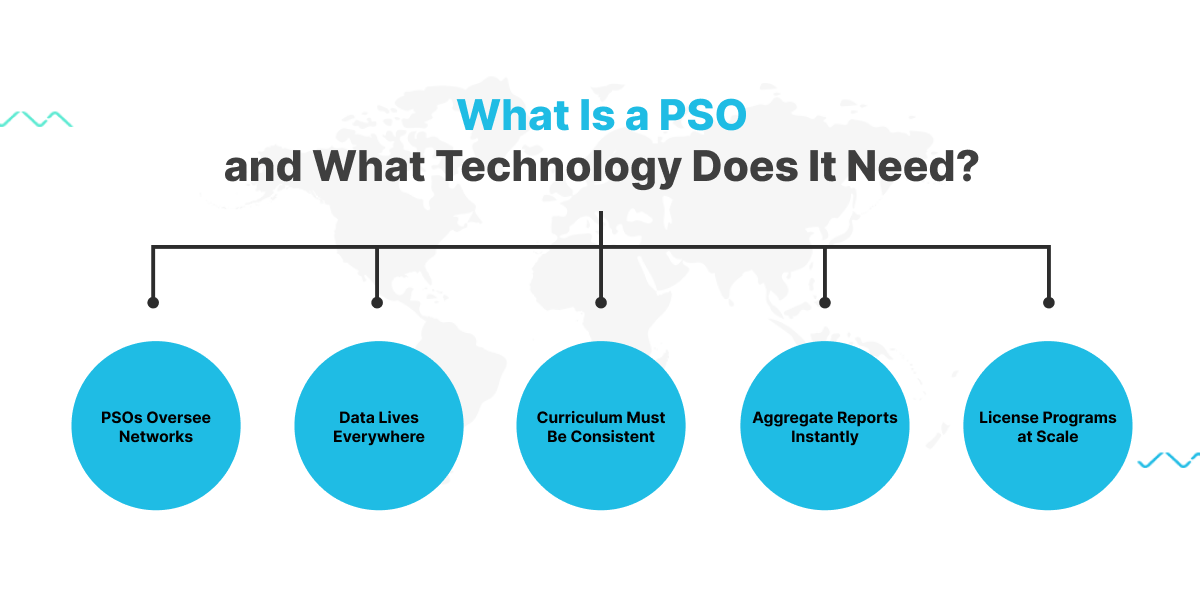
Why Managing a Network of Clubs Is Fundamentally Different From Managing One Club
The core operational challenge for a PSO is that it is accountable for what happens across its entire affiliate network but does not directly control what happens at each individual club. It sets standards and provides resources, but the implementation of those standards happens at the club level, by coaches and administrators who were not hired by the PSO and who may be working with different tools, different processes, and different levels of administrative capacity.
This creates a specific problem with data. When a PSO needs to report to Sport Canada on participation numbers, demographic breakdowns, and athlete progression rates across its province, it has to collect that information from every affiliated club. Each club has its own records, in its own format, maintained to its own standard of completeness and accuracy. Assembling those records into a meaningful provincial picture requires a significant amount of manual work, and the result is always a picture that is weeks or months out of date by the time it is assembled.
The same problem applies to program quality. A PSO that sets national curriculum standards for how athletes should be evaluated cannot verify whether those standards are being applied consistently across its affiliate network without a system that captures evaluation data in a standardized format from every club simultaneously.
Starlight Sailing Adventures in British Columbia ran into exactly this challenge before adopting Checklick. Before the switch, there was no central system for syncing Sail Canada certifications with participant tracking. Booking calendars were scattered across platforms and email threads, and instructor availability had to be confirmed manually for each course. Admin work was disjointed and time-consuming. After adopting Checklick, which is a Sail Canada-recognized platform, the school was able to manage evaluations and certifications in one place, eliminate spreadsheets and paperwork, and give instructors real-time access to class rosters. The platform centralized records, supported audit trails, and ensured compliance with national standards without any additional manual effort. Read the Starlight Sailing Adventures success story
That kind of centralized, audit-ready data infrastructure is exactly what PSOs need across their entire affiliate network.
The Four Technology Needs That Every PSO Has
There are four specific technology needs that define what a PSO requires to manage its affiliate network effectively. These needs are distinct from what an individual club needs, and most software that is designed for clubs does not address them.
The first is a curriculum distribution system that ensures consistency. A PSO needs to be able to distribute its athlete development frameworks and evaluation criteria to every affiliated club in a format that those clubs can actually use. More importantly, it needs to be confident that the criteria being applied at Club A in one city are identical to the criteria being applied at Club B in another city. A PDF document that each club interprets in its own way does not achieve this. A platform where the criteria live centrally and are accessed by coaches at every club through a consistent interface does.
Checklick’s Evaluation Marketplace enables exactly this. PSOs and NSOs can build their skill checklists inside the platform and make them available to affiliated clubs through the marketplace. Clubs license those checklists and their coaches use them to evaluate athletes. The evaluation data flows back to the PSO in real time. When the curriculum changes, the update reaches every licensed club simultaneously without anyone having to redistribute a document. See how Checklick’s Evaluation Marketplace works
The second is aggregate data reporting without manual compilation. At any point in the year, a PSO administrator should be able to pull a report showing participation numbers, demographic breakdowns, and athlete progression data across the entire provincial network, without contacting each affiliated club and waiting for them to submit their records.
The third is program licensing and sub-licensing capability. For PSOs with large affiliate networks, managing every individual club relationship at the provincial level creates its own administrative burden. The ability to license programs to regional partners, who then manage re-licensing to local clubs, allows the PSO to maintain standards and receive data across a large network without managing every individual relationship directly. Checklick is the only system to easily manage the licensing of programs to training centers, which makes it the right infrastructure for PSOs operating at this scale. See how Checklick’s program licensing works
The fourth is support availability that matches when sport happens. PSOs support clubs that run programs on evenings and weekends, and they need their own tools to be available and supported during those hours. Checklick offers phone and email support including weekends, which makes a practical difference for organizations whose work does not stop at five o’clock on Friday.
What PSOs Currently Use and Why It Creates Problems
Most PSOs currently manage their affiliate networks through a combination of email, spreadsheets, and whatever registration or management tools their individual clubs happen to use. This works well enough when the network is small and the reporting requirements are light. It creates serious operational problems at scale.
The fragmentation of data across dozens of clubs using different tools means that assembling a provincial picture of program delivery requires weeks of manual work. The inconsistency of evaluation criteria across clubs that each interpret national standards in their own way means that the data, once assembled, is not reliable enough to support meaningful comparison or trend analysis. And the dependence on manual communication for curriculum updates means that changes to national standards can take months to reach every affiliated club in the network.
These problems are directly relevant to the funding environment PSOs operate in. Government funders and sport oversight bodies increasingly require evidence-based reporting on athlete development outcomes. A PSO that cannot produce accurate, consistent, timely data across its affiliate network is in a weaker position with funders than one that can.
Getting the Right Infrastructure in Place
For PSOs that are ready to move beyond the spreadsheet-and-email model, the starting point is the Evaluation Marketplace. Building provincial skill checklists in Checklick and making them available to affiliated clubs through the marketplace creates the consistent data foundation that everything else depends on. See how Checklick’s evaluation tools work
Checklick is used by hundreds of sports clubs across Canada and Ireland and is rated 4.7 on GetApp and Software Advice. It is an all-in-one Athlete Development Tracking System and Sports Club Management System that was designed specifically for the needs of sport development organizations at the club and governing body level.
Frequently Asked Questions
What is a Provincial Sport Organization in Canada?
A Provincial Sport Organization (PSO) is the governing body for a specific sport within a Canadian province or territory. It operates between the National Sport Organization and individual clubs, overseeing athlete development pathways, coaching programs, provincial competitions, and funding compliance across its affiliate network.
What is the difference between a PSO and an NSO?
A National Sport Organization (NSO) sets national standards and policies for a sport across Canada. A PSO implements those standards at the provincial level and manages relationships with affiliated clubs within its province. RSOs serve a similar function at the regional level.
What software does a PSO need to manage affiliated clubs?
PSOs need a platform that can distribute standardized evaluation criteria to affiliated clubs, collect athlete development data from those clubs in a consistent format, aggregate that data into provincial reports, and support program licensing at scale. These needs are distinct from what individual clubs require and are not well served by generic club management software.
How does Checklick support PSOs specifically?
Checklick’s Evaluation Marketplace allows PSOs to build their skill checklists centrally and license them to affiliated clubs. Evaluation data from every licensed club flows back to the PSO in real time. Sub-licensing allows regional partners to manage club relationships within their area. The result is consistent data across the entire affiliate network without manual collection.
Learn more and request a consultation at checklick.com
