

Most software subscription models are built around the assumption that the user is getting value from the product every month. For many types of software this is a reasonable assumption. An email platform, a CRM, an accounting tool – these are used continuously throughout the year and a monthly fee reflects ongoing value.
Sports club registration software is different. For a very large proportion of the clubs that need it, registration software is used intensively for a few months a year, lightly for a few more months, and not at all for several months when no programs are running.
A sailing club in Ontario runs programs from May through September. A wrestling club has its main season from October through March. A summer sailing camp is operational for eight weeks in July and August. These are seasonal operations, and for all of them, a monthly subscription fee that runs twelve months of the year is charging for value the club is not receiving for a significant portion of the year.
For context on the broader question of how to choose the right registration software, our earlier blog on how Canadian youth soccer clubs can turn World Cup excitement into registration growth covers the registration experience fundamentals that matter for any club regardless of pricing model.
The Real Cost of Monthly Subscription Pricing for Seasonal Clubs
The headline monthly fee for most registration software platforms looks manageable in isolation. Forty dollars a month. Sixty dollars a month. Maybe more for platforms with more features. In isolation, these are not dramatic numbers.
But for a club that runs programs for five months of the year, a monthly subscription means paying for twelve months while receiving real value for five. The effective cost per active month is more than double the advertised monthly fee. And during the seven months when no programs are running, the club is paying for software it is not using because cancelling and resubscribing every season creates its own administrative burden.
This is a particularly important consideration for the many sports clubs in Canada that operate on modest budgets with minimal administrative staff and no dedicated budget for software tools. For these clubs, the distinction between a pricing model that charges proportionally to activity and one that charges a flat monthly rate regardless of activity is not a minor preference. It is a meaningful financial decision.
What Transaction-Based Pricing Actually Means
Transaction-based pricing charges the club a percentage of each registration payment collected rather than a flat monthly fee. The cost scales directly with revenue. When programs are full and registrations are flowing, the platform cost is proportional to the revenue being generated. When no programs are running and no registrations are being collected, the cost is zero.
For seasonal sports clubs, this alignment between software cost and program activity is a fundamentally better model than flat monthly pricing. A club collecting ten thousand dollars in registration fees in a season pays a known, proportional amount. In the off-season, it pays nothing.
Checklick’s Storefront operates on exactly this model. It charges 4.9% per transaction with no monthly fees and no long-term contract. A club that generates two thousand dollars in registration fees pays ninety-eight dollars in platform costs. A club that generates twenty thousand dollars pays nine hundred and eighty dollars. During months when no programs are running and no transactions are being processed, the cost is zero. See Checklick’s full pricing
There are no setup fees, no annual contracts, and no penalty for not using the platform during the off-season. The pricing model is aligned with how seasonal sports clubs actually operate.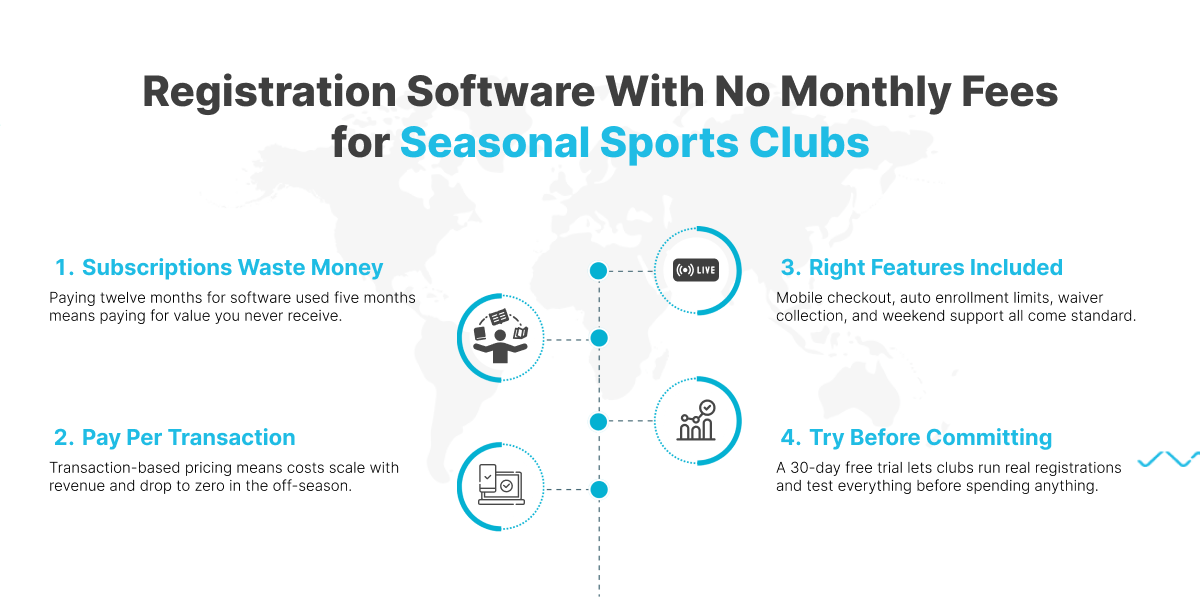
What the 4.9% Model Looks Like in Practice
For clubs that are evaluating whether transaction-based pricing makes sense for them, a simple comparison is useful.
Consider a summer sailing camp that runs for eight weeks and collects twenty-five thousand dollars in registration fees across its programs. Under a transaction-based model at 4.9%, the platform cost for the season is twelve hundred and twenty-five dollars. Under a monthly subscription model at sixty dollars per month for a full year, the annual cost is seven hundred and twenty dollars, but during the seven months when the camp is not operating, the club is paying four hundred and twenty dollars for nothing.
The total cost difference is relatively modest in this example. But the critical difference is alignment: the transaction-based model only charges when the club is generating revenue, while the subscription model charges regardless.
For clubs with tighter budgets where every expense needs to be justified by direct value, the alignment of cost with activity is not just a financial preference. It is a governance and accountability consideration. A club treasurer who can point to a platform cost that is directly proportional to program revenue is in a much easier position than one who has to explain a year-round subscription charge for software that is idle for half the year. See how Checklick’s Storefront works
What Else Seasonal Clubs Need to Consider
Pricing model is one dimension of the decision. The features that the pricing gets you are another.
For seasonal sports clubs, the most critical features are a mobile-optimized checkout that families can complete on any device, automatic enrollment limits that prevent overbooking, waiver collection within the registration flow, real-time enrollment visibility for administrators, and support that is available during the evenings and weekends when programs actually run.
Checklick’s Storefront includes all of these. The checkout is optimized for any screen size. Enrollment limits are set per program and enforced automatically. Waivers are collected within the checkout flow. Administrators can see real-time enrollment status across all programs. And phone and email support is available including weekends.
West Hawk Lake Yacht Club in Manitoba, a seasonal sailing organization serving thirty to fifty sailors each summer, found that after switching to Checklick, registration became fully digital with all paper forms and cash handling eliminated. Financial reporting became easier and more transparent. Instructors got real-time access to updated class lists. And the improved mobile experience, particularly on iPhones, reduced participant complaints. The platform delivered exactly what a seasonal club needs: the right features, available during the right hours, at a cost that reflects actual program activity. Read the West Hawk Lake Yacht Club success story
The 30-Day Free Trial
For clubs that are evaluating whether to switch from a monthly subscription platform or from manual registration processes, Checklick’s 30-day free trial allows a complete test of the platform’s capabilities before any financial commitment.
A club can set up its programs, configure enrollment limits and waivers, run a real registration period, and assess the full experience for both administrators and families before deciding whether the platform is the right fit. See how other clubs made the switch to Checklick
Frequently Asked Questions
Why do seasonal sports clubs pay more than they should for registration software?
Most registration software uses monthly subscription pricing that charges clubs regardless of whether programs are running. For clubs with seasons of five to eight months, this means paying for the software during off-season months when it is not generating any value.
What is transaction-based pricing for sports registration software?
Transaction-based pricing charges a percentage of each registration payment collected rather than a flat monthly fee. The cost scales directly with program revenue. When no programs are running, the cost is zero. Checklick’s Storefront charges 4.9% per transaction with no monthly fees or long-term contracts.
Is 4.9% per transaction a good deal for a sports club?
For most clubs, yes. The total cost is transparent, predictable, and proportional to revenue. There are no off-season charges, no setup fees, and no annual contract penalties. For seasonal clubs, this alignment between cost and activity is a better model than monthly subscriptions.
Can a sports club try Checklick’s Storefront before committing to it?
Yes. Checklick offers a 30-day free trial that allows clubs to set up programs, run registrations, and test the full platform experience before making any financial commitment.
Start your free trial at checklick.com and find out what registration software that charges only when you earn actually feels like to use.
