
Funding from Sport Canada and provincial sport funding bodies does not come with a simple administrative requirement to submit a participant count at the end of the year. It comes with a reporting obligation to demonstrate that the programs it supported delivered measurable outcomes for athletes and for the sport.
That distinction matters enormously for the organizations that receive this funding. Submitting a participant count is straightforward. Demonstrating measurable program impact with structured, verifiable data is a fundamentally different task, and one that most sport organizations are not as well prepared for as they assume.
This blog explains what Sport Canada and provincial funding bodies actually want to see in program data submissions, why most organizations struggle to provide it in a timely and credible format, and how a connected athlete development tracking system changes the reporting process completely. You can also read about how the LTAD framework shapes what funders expect in our blog on the LTAD framework and how digital athlete tracking makes it measurable
What Sport Canada’s Reporting Requirements Actually Look Like
The Government of Canada’s Sport Support Program provides financial assistance to eligible National Sport Organizations for activities that enhance the Canadian sport system. Organizations that receive this funding are accountable for demonstrating how it was used and what outcomes it produced.
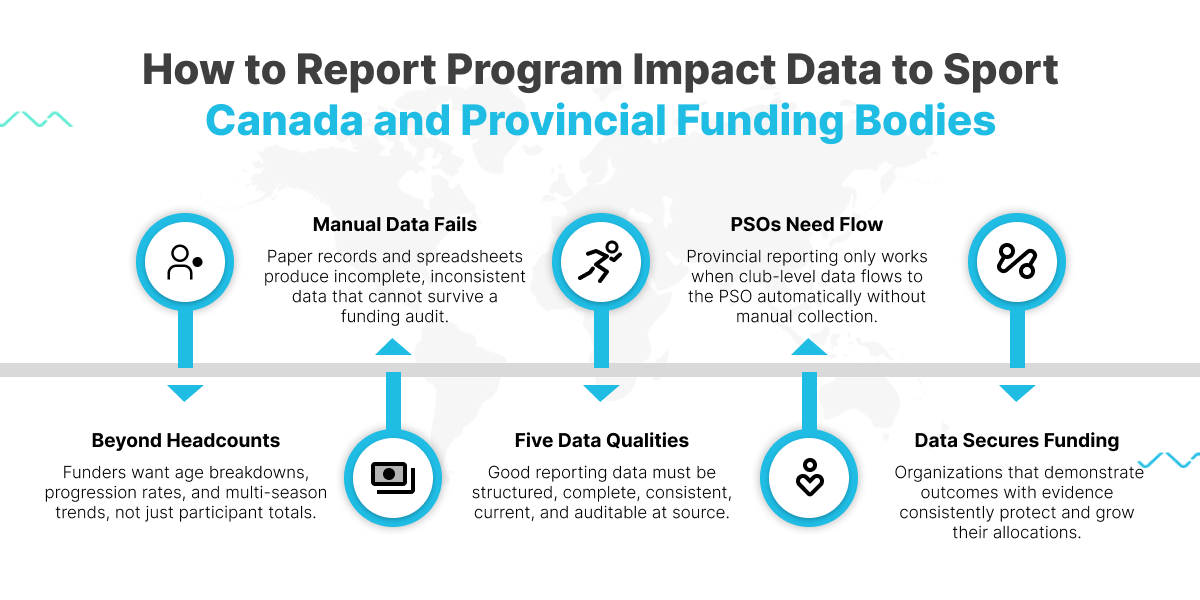
The data Sport Canada and provincial equivalents look for in reporting submissions goes well beyond registration numbers. They want participation data broken down by age and gender to assess whether programs are reaching the intended demographic groups. They want athlete progression data showing how participants advanced through program levels across the season. They want evidence of coaching quality and program delivery consistency. And increasingly, they want multi-season trend data that demonstrates sustained impact rather than a single good year.
For PSOs and NSOs that manage programs across dozens or hundreds of affiliated clubs, producing this data requires either a centralized system that collects it automatically from every club or a manual process of requesting, collecting, normalizing, and compiling data submissions from each affiliated club. The manual process is not only time-consuming. It produces data that is inconsistent in format, variable in completeness, and often several weeks old by the time it is assembled. See how Checklick centralizes athlete development data across affiliate networks
Why Most Organizations Struggle With Data Reporting
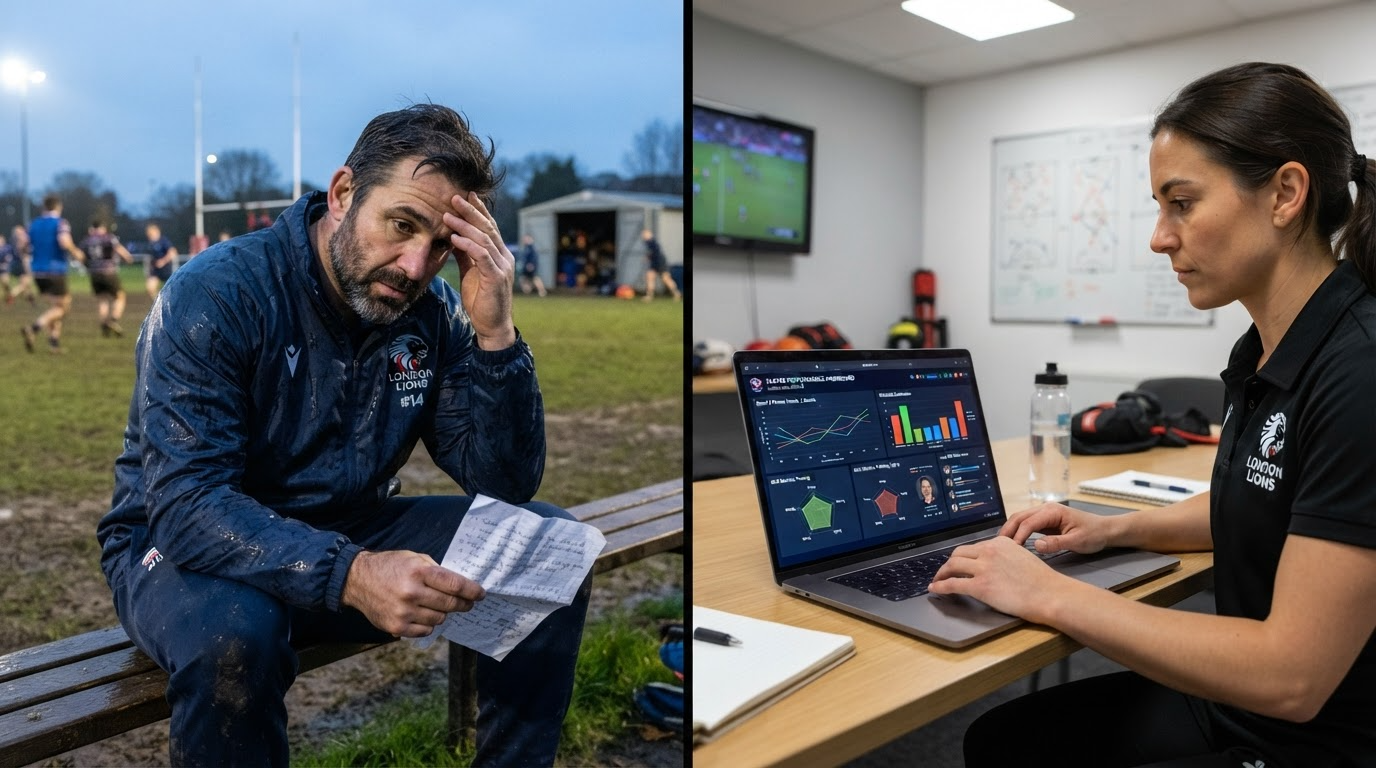
The challenge is not usually that sport organizations are not running good programs. The challenge is that the programs are often not generating data in a format that can be efficiently compiled into the kind of structured report that funders require.
When coaches evaluate athletes on paper and results are kept in individual files, the evaluation data exists but is not accessible or aggregable without manual effort. When clubs in a provincial network use different evaluation criteria or different measurement scales, the data cannot be meaningfully compared across the network without normalization work. And when participation records are maintained in spreadsheets that are updated manually by individual administrators, the data is always a few steps behind reality and never quite in the format that the funding body’s reporting template requires.
Grapple Yukon Association and Northern Lights Judo Club illustrate what the starting point looks like for a volunteer-run sports organization building toward credible program reporting. Before adopting Checklick, registrations and memberships were tracked manually, data access was limited to specific devices and locations, and managing records remotely was not possible. After adopting Checklick for registration and membership management, records became instantly accessible from anywhere, registrations and memberships were centralized and trackable, and operations became fully digital. For a volunteer-run organization with a travelling administrator, this shift from manual and location-dependent records to centralized digital ones is the essential first step. Organizations cannot report credibly on program impact if they cannot reliably access their own registration and membership records. Getting that foundation in place is what makes everything else possible Read more success stories from clubs using Checklick
What Good Program Impact Data Actually Looks Like
Good program impact data for Sport Canada reporting has five characteristics. It is structured, meaning it is organized in a consistent format with defined fields rather than in free-form notes. It is complete, meaning it covers all participants across all programs in the reporting period without gaps. It is consistent, meaning the evaluation criteria and measurement scales are the same across all coaches and all sessions so the data can be meaningfully compared. It is current, meaning it reflects what actually happened in programs rather than what was remembered about programs after the fact. And it is auditable, meaning it comes from a system that maintains a record of who entered what data when, so the numbers in the report can be traced back to source evaluations.
When athlete development data is collected through a platform like Checklick, all five of these characteristics are present by default. Coaches evaluate athletes on mobile devices during sessions, producing structured evaluations in real time. The evaluations flow immediately into a centralized system, so the data is complete and consistent across all coaches. Reporting tools aggregate the data into the formats that administrators need without manual compilation. And the platform maintains an audit trail of every evaluation, so the data in any report can be traced back to the session and coach that produced it. See how Checklick’s evaluation platform works
How PSOs Can Build Reporting Infrastructure Across Their Affiliate Networks
For PSOs that need to produce provincial-level program impact data for provincial sport funding bodies, the challenge is compounded by the fact that the data they need does not live in one place. It lives across every affiliated club in their network.
The path to credible provincial reporting is building the infrastructure that makes club-level data flow to the PSO automatically rather than having to be collected manually at reporting time. This requires affiliated clubs to be using the same evaluation framework, recorded in the same platform, in the same format. When that infrastructure is in place, the PSO administrator can pull a provincial participation and progression report at any point in the year without contacting a single club or waiting for anyone to submit anything.
Checklick’s Evaluation Marketplace enables this directly. PSOs build their evaluation frameworks inside Checklick and make them available to affiliated clubs through the marketplace. Clubs license the frameworks and their coaches use them to evaluate athletes. The data flows back to the PSO in real time. Checklick is the only system to easily manage the licensing of programs to training centers, which is what makes provincial-scale data collection operationally viable rather than administratively burdensome. See how Checklick’s Evaluation Marketplace works
The Connection Between Reporting Quality and Funding Security
The organizations that consistently protect and grow their funding from Sport Canada and provincial bodies are not necessarily the ones running the best programs. They are the ones that can demonstrate most clearly that their programs are producing outcomes.
A PSO that can submit a funding report showing detailed participation data by age and gender, athlete progression rates by program level, multi-season trend data demonstrating year-over-year improvement, and an audit trail confirming that the data is complete and accurate is in a fundamentally stronger position with funders than one that submits a summary of what it believes happened based on manually compiled information.
The difference between these two positions is not a difference in program quality. It is a difference in data infrastructure. Building that infrastructure now, before the next reporting cycle, is the most direct investment a sport organization can make in its funding security.
Frequently Asked Questions
What data does Sport Canada require in program impact reports?
Sport Canada looks for participation data broken down by demographic characteristics, athlete progression data showing advancement through program levels, evidence of coaching quality and program consistency, and multi-season trends demonstrating sustained impact. Specific requirements vary by funding program and organization type.
How can a PSO collect program data from all its affiliated clubs without manual submissions?
Using a platform like Checklick, PSOs can distribute standardized evaluation frameworks to affiliated clubs through the Evaluation Marketplace. When clubs use those frameworks to evaluate athletes, the data flows back to the PSO automatically in a consistent format, enabling provincial-level reporting without manual data collection.
What makes program data credible for funding body review?
Credible program data is structured, complete, consistent across all coaches and sessions, current, and auditable. A centralized digital platform that records evaluations in real time and maintains an audit trail produces data with all of these characteristics.
How long does it take to set up a reporting-ready athlete development tracking system?
Checklick can have a basic program infrastructure live within three days. For PSOs deploying the system across an affiliate network, the timeline depends on the number of affiliated clubs and the complexity of the evaluation framework being deployed.
Learn more and request a consultation at Start your free trial at checklick.com
