

How Sailing Clubs Manage CANSail and National Certifications Without the Paperwork
Running a sailing club is not just about teaching people to sail. It is about making sure that when a sailor earns a certification, there is a reliable record of it. When an instructor signs off on a CANSail level, that sign-off is documented, accessible, and compliant with national standards. And that when a new instructor joins mid-season, they can see exactly where every student stands without having to ask around or dig through files.
For most sailing clubs, this is one of the hardest parts of the job. And for a long time, clubs have been managing it the hard way.
The Real Challenge With Certification Tracking
Certification programs like CANSail are well designed. They give sailing clubs a clear, structured pathway for developing sailors at every level, from complete beginners learning to rig a boat all the way through to advanced cruising and racing skills. The structure is there. The standards are defined. The problem is not the program itself. The problem is managing it across a full season of participants, multiple instructors, and an organization that often runs on volunteer time.
Before digital tools, certification tracking at most sailing clubs meant paper forms. An instructor evaluated a sailor, marked off skills on a printed checklist, and filed the form somewhere. At the end of the season, someone had to collect all those forms, verify the completions, and submit records to the national body. If a form was missing or illegible, there was a problem. If an instructor left before submitting their records, there was a bigger problem. And if a parent asked for proof of their child’s certification level, finding the right form in the right file was its own challenge.
Some clubs moved to spreadsheets to solve this. That helped with storage, but it did not solve the core problem. Spreadsheets are not connected to anything. They do not sync between instructors. They do not automatically generate reports or flag incomplete certifications. And they are only as accurate as the person entering the data, which is a meaningful limitation when you have a dozen instructors updating their own files during a busy sailing season.
What Sailing Clubs Actually Need
What sailing clubs need for certification management is not a filing system. It is a live, connected system where evaluation data flows from the instructor to the club to the national body without manual steps at every stage.
That means instructors need to be able to record skill completions in real time, right on the dock or the water, on a device they already have in their pocket. It means administrators need to see that data immediately, not at the end of the week when someone gets around to submitting their form. It means parents need to be able to see their child’s progress without calling the club to ask. And it means the club’s records need to be audit-ready at any point in the season, not just after a big manual effort at the close of programs.
This is exactly the problem Checklick was built to solve for sailing clubs. Checklick is a Sail Canada recognized platform, which means it is not just a general sports club tool that sailing clubs happen to use. It was developed closely with Sail Canada to manage CANSail certifications specifically, and it is recognized for certification tracking within the national program framework.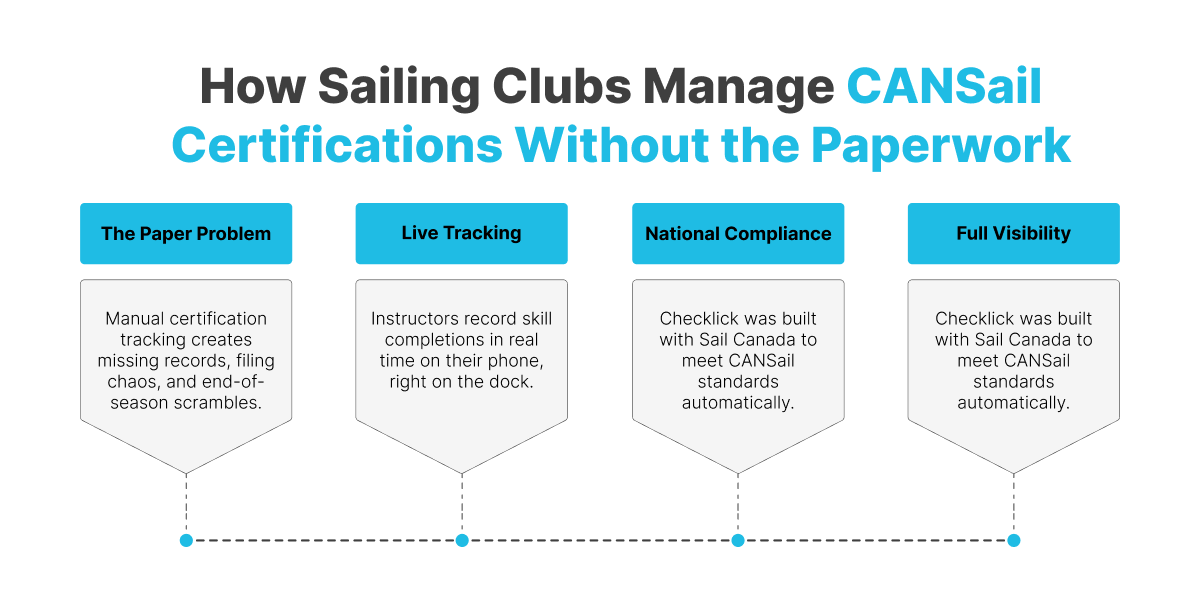
How It Works in Practice
Starlight Sailing Adventures is a seasonal sailing school in British Columbia that offers Basic and Intermediate Cruising courses along with official Sail Canada certifications. Before using Checklick, they managed key tasks manually, especially around instructor coordination and certification tracking. Booking calendars were scattered across platforms and email threads. Instructor availability had to be confirmed manually for each course. And there was no central system for syncing Sail Canada certifications with participant tracking.
After adopting Checklick, all of that changed. Checklick enabled Starlight Sailing to manage evaluations and certifications in one place, eliminate spreadsheets and paperwork, and give instructors real-time access to class rosters. Records became centralized, audit trails were supported automatically, and the school achieved compliance with Sail Canada standards without any additional manual effort. The outcome was a stronger professional presence, a scalable system for future growth, and fully digital certifications across all their programming.
Port Dover Yacht Club dealt with a similar challenge. With changing CANSail levels, new instructors joining each season, and growing interest in advanced programming, they needed a way to keep certification tracking accurate without putting more pressure on their volunteer staff. Checklick helped them navigate the updated CANSail pathways and manage the complexity of sailors progressing through levels at different rates, including a new two-week program structure that gave sailors more time to complete higher certification levels in one enrollment period.
Why National Certification Compliance Is Getting Harder to Manage Manually
Sailing certification programs are not static. They get updated. CANSail levels change. New program structures get introduced. Standards evolve. Every time that happens, clubs using paper or spreadsheets have to manually update their tracking systems, retrain their instructors on what to look for, and hope that nothing gets missed in the transition.
A digital platform like Checklick removes most of that friction. When certification criteria change, the platform adapts. Instructors work from the same updated criteria regardless of which course they are running or which location they are based at. And because all records are centralized, administrators can see immediately whether the updated standards are being applied consistently across the whole program.
For clubs that are part of a larger sailing organization or that report to a national body, this consistency is not just convenient. It is required. Funders, governing bodies, and certification authorities want to see accurate, verifiable records. Clubs that can produce those records quickly and confidently are in a much stronger position than those still trying to compile paper files after the season ends.
What Instructors Experience
One of the most common frustrations for sailing instructors is the gap between the work they do on the water and the administrative record of that work. They spend hours teaching, evaluating, and coaching. But getting that activity into a form that the club can actually use means extra steps after the fact, steps that eat into their time and often get pushed aside when things are busy.
Checklick eliminates most of those steps. Instructors evaluate participants directly on their phone or tablet during sessions. The skills they mark off appear immediately in the club’s system. They do not have to fill out a separate form, email a spreadsheet, or remember to submit their records at the end of the week. The evaluation is the record.
That simplicity has a meaningful effect on data quality. When recording an evaluation takes seconds rather than minutes, instructors do it consistently. When doing it consistently does not create extra work, they do not fall behind. The result is a more complete, more accurate picture of where every sailor stands at any point in the season.
What Administrators and Parents Get
For club administrators, real-time certification data changes how the whole operation runs. Instead of collecting and verifying records at the end of the season, administrators can check program status at any point. They can see which sailors are on track to complete their certification, which instructors are up to date with their evaluations, and where any gaps might be forming before they become problems.
For parents, the experience is equally different. Instead of waiting for end-of-season reports or calling the club to ask about their child’s progress, they can see exactly where their sailor stands in the certification pathway. That visibility matters, especially for families whose children are working toward specific certification levels for competitive sailing or further training. It also builds trust in the club’s programs in a way that a verbal update at pickup never quite does.
Port Credit Yacht Club used Checklick’s built-in progression displays to show parents exactly where each participant stood in the program pathway. For a club that was working to retain young sailors after their first seasons, that kind of transparency made a direct difference in re-enrollment rates.
Getting Your Sailing Club Set Up
If your club is still managing CANSail certifications on paper or in spreadsheets, the path to a better system is shorter than you might expect. Checklick is built specifically for sailing clubs and national certification programs. The setup process is straightforward, and the Checklick team provides hands-on support through the transition, including phone and email support on weekends when your programs are actually running.
Checklick’s evaluations platform starts at fifteen dollars per month for clubs with under fifty evaluators. There is a thirty-day free trial so you can see how the system fits your club’s workflow before committing to anything.
The paperwork side of running a sailing club does not have to be the hardest part. With the right system, certification tracking becomes something that happens naturally as part of coaching, not a separate administrative burden that piles up throughout the season.
Learn more about how Checklick supports sailing club certification management at checklick.com, or request a consultation to see how it fits your club’s specific programs.
