

If you have ever spent a Saturday morning chasing down payment envelopes, counting cash at a folding table, or sending a third reminder email to a family who still has not paid, you already know the problem.
Cash payments feel simple on the surface. But for the people running sports clubs, they create a layer of admin work that never really goes away. And in 2026, more clubs are finally deciding that enough is enough.
This article looks at why cash payments are a problem for sports clubs, what the real costs are, and what clubs are using instead.
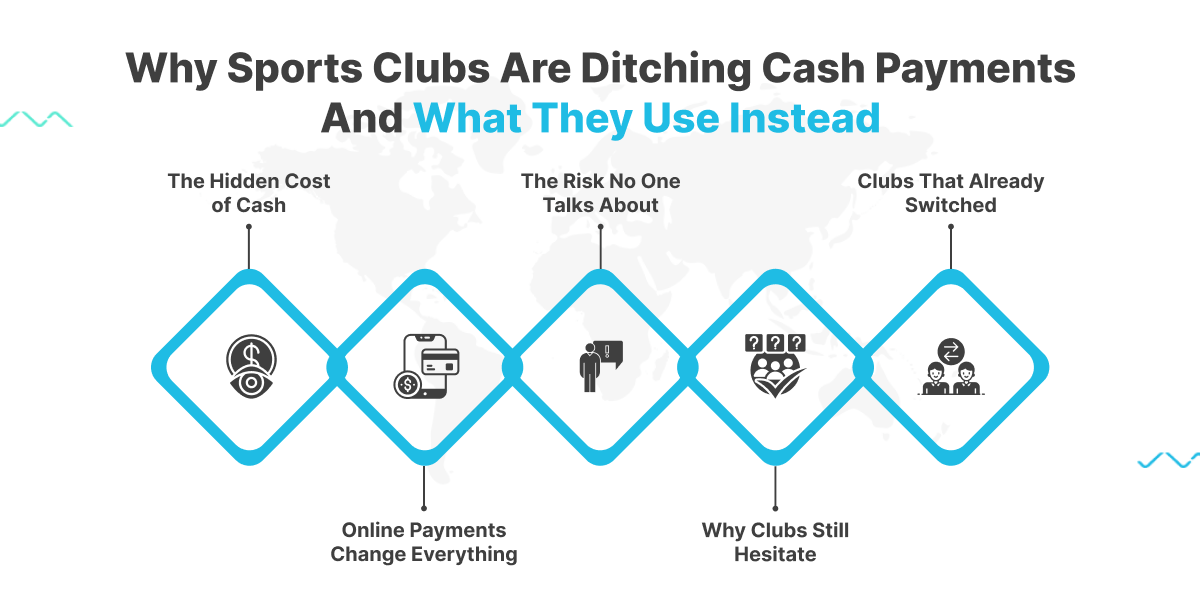
The Hidden Cost of Collecting Cash
Most clubs do not think of cash collection as a major issue. It is just part of how things have always been done. But when you add up the time and risk that comes with it, the picture changes quickly.
Here is what cash payment collection actually involves for a typical sports club. A volunteer or administrator has to be present to collect payments in person. They have to track who has paid and who has not, usually in a spreadsheet or on a paper list. They have to follow up with families who missed the deadline. They have to store the cash securely until it can be deposited. Then they have to make the trip to the bank. Then they have to reconcile what came in against what was expected.
Every one of those steps takes time. And every one of those steps can go wrong.
Payments get misplaced. Receipts do not get issued. A family insists they paid when there is no record of it. A volunteer forgets to hand over the envelope. A young athlete is put in the uncomfortable position of carrying money to practice.
These are not edge cases. They happen at clubs all the time. And they happen because cash, as a payment method, has no accountability built into it. There is no automatic confirmation. No digital record. No paper trail unless someone creates one manually.
What Happens When Clubs Move to Online Payments
The shift to online payments is not just about convenience. It changes how clubs operate at a fundamental level.
When a family registers and pays online, the transaction is recorded instantly. The club receives confirmation automatically. The family receives a receipt without anyone having to print or hand one over. The data flows directly into the club’s system without manual entry. And the money goes straight to the club’s bank account without anyone making a trip to deposit it.
That chain of events removes almost every failure point that comes with cash collection. There is nothing to lose, nothing to misplace, and nothing to chase down after the fact.
Gimli Yacht Club experienced this directly. Before switching to online registration and payment, they handled signups through email and collected payments by cash or cheque, often not until after the program had ended. Chasing down registration fees stretched well into the fall season, adding strain to their administration process. After moving to Checklick’s Storefront, all registrations required payment by credit card at the time of signup. The problem disappeared almost immediately. With 80 participants going through the system, the club now saves roughly 20 volunteer hours every year just from removing that manual payment process.
West Hawk Lake Yacht Club had a similar outcome. Cash handling was eliminated entirely through online registration. Financial reporting became easier and more transparent. Instructors got real-time access to updated class lists. The club went from operating with a patchwork of manual processes to running a fully digital registration and payment system.
The Risk No One Talks About
There is one part of cash-based payment collection that clubs rarely discuss openly, and that is the risk it creates for young people.
When a club collects cash at practice or at the start of a program, it is often children and teenagers who are responsible for carrying that money from home to the coach or administrator. That means minors handling significant sums of money, sometimes in cash-filled envelopes, in a sports setting.
Barrie Yacht Club identified this risk directly. Their previous system required cheque payments, which posed several problems including minors handling large sums of money and misplaced payments. When they switched to Checklick’s Storefront, that risk was removed entirely. Parents paid online at the time of registration. No money changed hands at the club. No one had to carry anything.
That is a meaningful change, not just for operational efficiency but for the safety and dignity of the young athletes your club serves.
Why Some Clubs Still Hesitate
If online payments are clearly better, why do some clubs still rely on cash? Usually it comes down to one of three concerns.
The first is cost. Some clubs worry that payment processing fees will eat into their revenue. This is a real consideration, but the math usually favors digital payments when you account for the volunteer hours saved and the reduction in missed or late payments. Checklick’s Storefront charges 4.9% per transaction with no monthly fees and no long-term contracts. You only pay when your club makes a sale. There is no subscription cost sitting on your books during the off-season.
The second concern is setup complexity. Administrators assume it will take weeks or require technical expertise to get a payment system running. In practice, Checklick can have your storefront live within three days of getting started. You add your courses, memberships, and events, set your pricing, and you are ready to accept payments. It is built so that any club administrator can do it without needing help from a developer.
The third concern is member adoption. Will families actually use it? In most cases, yes. Families prefer online registration because it is faster and more convenient than showing up with cash or mailing a cheque. The clubs that make the switch consistently find that their members adapt quickly and that the complaints come from the minority who are most comfortable with old habits, not from the majority.
What to Look for in an Online Payment System for Sports Clubs
Not every payment platform is built with sports clubs in mind. A generic e-commerce tool might handle transactions, but it will not manage enrollment limits, collect waiver forms, or give you the registration data you need to run your programs properly.
When evaluating options, look for a system that handles the full registration flow, not just the payment. That means families should be able to select a program, fill in any required information, agree to a waiver if your club requires one, and pay, all in one step. The moment that transaction is complete, your club should have a record of everything.
Look for branded receipts that go out automatically. Families trust a process that looks professional and gives them confirmation right away.
Look for direct bank deposits so your club’s revenue goes where it belongs without sitting in a third-party account.
Look for support that is actually available. Running a sports club is not a nine-to-five job, and your payment questions should not have to wait until Monday morning. Checklick offers phone and email support including weekends, which matters when you are trying to get registration open before a season starts.
And look for flexibility. You should be able to sell courses, memberships, event tickets, and merchandise all in one place. Checklick’s Storefront handles all of it, so you are not piecing together multiple tools to cover different parts of your program.
The Clubs That Have Already Made the Switch
Port Dover Yacht Club moved to online registration and payment and saw immediate results. A new program they launched sold out. Cash handling was eliminated. Families and staff found the process easier from the first day.
Barrie Yacht Club resolved their payment and refund issues, removed the risk associated with cash collection, and gained the ability to set up tiered sponsorship levels for external partners through Checklick, opening up a new funding stream they did not have before.
These are not large organizations with big IT budgets. They are volunteer-run and staff-run sports clubs that made a practical decision to stop doing things the hard way.
You Do Not Have to Keep Chasing Payments
If your club is still collecting cash or waiting for cheques to arrive, every registration season is harder than it needs to be. Your volunteers are spending hours on tasks that a good payment system handles automatically. Your members are dealing with a registration process that feels outdated. And your club is carrying more financial risk than it should.
Checklick’s Storefront was built specifically for sports clubs that are ready to move on from manual payment collection. No monthly fees. No technical setup headaches. A 30-day free trial so you can see how it works before committing.
Start your free trial at checklick.com and find out how quickly your club can stop chasing payments and start running smoother programs